
Oversized Load Transport vs Waste Disposal Compliance
Table of Contents
Oversized Load Transport Permits: What Construction Managers Need to Know
Construction Waste Management Plan Requirements for Compliance
Roll-Off Bin Rental for Construction Sites: Sizing and Logistics
DIY vs Professional Hauling: A Cost-Benefit Analysis
Regional Regulatory Comparison for Waste and Oversized Loads
Liability Mitigation for Project Managers
Conclusion
Frequently Asked Questions
Last Updated: September 30, 2026
Oversized Load Transport Permits: What Construction Managers Need to Know
Moving a 40-tonne excavator or an oversize modular home across a provincial highway requires more than a truck and a driver. Oversized load transport in Canada is governed by a patchwork of provincial permit systems, each with its own weight thresholds, escort rules, and travel restrictions. At J&M Disposal Inc., we move construction and agricultural equipment across the region regularly, and the permit question comes up on nearly every job.
An oversized load transport permit is an official authorization issued by a provincial Ministry of Transportation that allows a vehicle or load exceeding standard legal dimensions or weight to travel on public roads. Without it, the move is illegal and the carrier faces fines, forced unloading, and liability for any damage.
The practical problem: permits are issued per province, sometimes per route, and rarely cover both your equipment move and the debris leaving the same site. That gap is where projects stall.
Watch Out A common mistake is assuming one permit covers the whole trip. If your route crosses a provincial boundary or enters a municipal road with lower weight limits, you may need a second authorization. Moving without it can result in the load being stopped mid-route and the project losing days.
Most managers handle equipment transport and waste disposal as two separate contracts. They shouldn't. Both involve the same regulatory compliance obligations, the same weight restrictions, and often the same trucks.
Construction Waste Management Plan Requirements for Compliance
A construction waste management plan is a written document that identifies each waste stream on a project, estimates volumes, and describes how material will be sorted, diverted, and disposed of. Many municipalities and provincial environmental regulators now require one before issuing a building or demolition permit.
The core requirements typically include:
A waste classification breakdown (clean fill, drywall, metal, concrete, hazardous materials)
Estimated tonnage per material type
Named disposal and recycling facilities
Diversion targets and how they will be tracked
Site storage and hauling logistics
Waste classification matters more than most managers expect. Mixing drywall into a general debris bin can contaminate an entire load and send it to landfill instead of recycling. Separating concrete, metal, and clean wood at the source keeps disposal costs down and keeps you inside diversion requirements.
For managers who have never written one, start with the waste streams you can actually measure. A plan built on guesswork fails a compliance audit faster than a plan with modest but accurate numbers.
Roll-Off Bin Rental for Construction Sites: Sizing and Logistics
Sizing a bin wrong costs money twice: once for the bin you didn't need, and again for the second pickup when the first one overflows. J&M Disposal Inc. offers bins from 5 to 40 yards, and the right size depends on material density as much as volume.
Heavy material like concrete, brick, and soil fills a bin fast. A 10-yard bin of clean concrete can weigh more than a 20-yard bin of mixed framing debris. Light demolition waste, drywall, and packaging take up space without much weight.
Bin Size | Best For | Watch Out For |
5-10 yard | Small renovations, concrete, soil | Fills fast with heavy material |
15-20 yard | Kitchen and basement gut jobs | Weight limits on dense debris |
22 yard | Mid-size demolition, mixed loads | Needs clear truck access |
40 yard | Full commercial fit-outs | Placement space and permit needs |
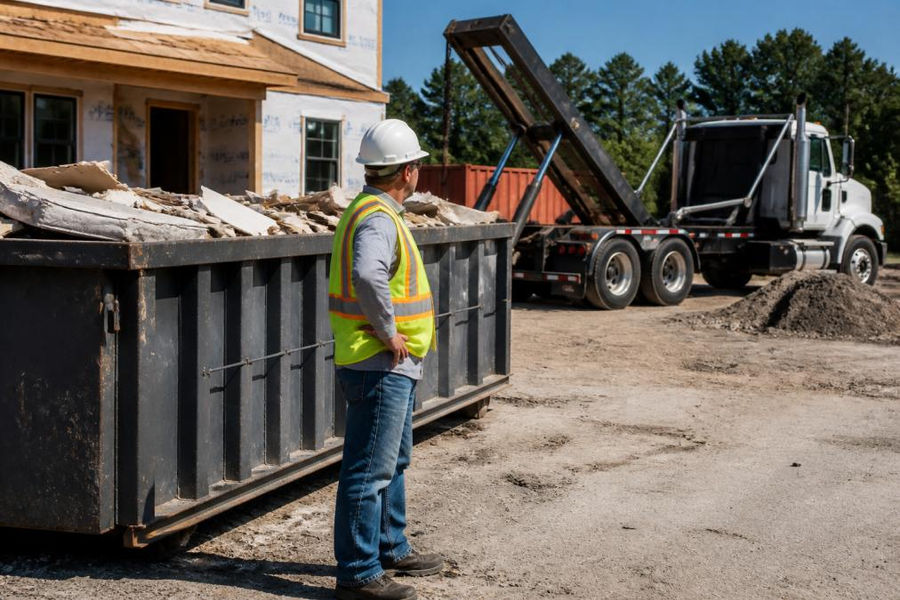
Logistics decide whether the bin works. A hook lift truck needs a clear approach and firm ground. Placing a bin on soft soil or a steep driveway risks a failed delivery and a wasted trip.
Pro Tip Ask about the weight allowance before the bin lands, not after. Heavy loads that exceed the included tonnage get charged per extra tonne, and that surprise shows up on the final invoice.
DIY vs Professional Hauling: A Cost-Benefit Analysis
The DIY route looks cheaper on paper. It rarely is once you count the real costs, and the biggest cost is the one most managers never put on the spreadsheet: compliance risk.
Start with the visible costs. DIY hauling means renting a truck or trailer, loading it yourself, making multiple trips to a transfer station, and paying tipping fees per load. Add fuel, labour hours, and the risk of an overloaded vehicle. A single improperly secured load can trigger a roadside inspection and a fine. On a renovation producing multiple tonnes of mixed debris, those trips multiply fast.
Professional hauling bundles the bin, the truck, the disposal, and the compliance paperwork into one service. You pay for the convenience, but you also pay for the fact that the hauler knows the regulations and carries the permits.
Factor | DIY | Professional Hauling |
Upfront cost | Lower per trip | Higher, all-inclusive |
Labour | Your crew's hours | Included |
Trips required | Multiple | Usually one |
Tipping fees | Paid per load, per trip | Bundled into service |
Compliance risk | High, you own it | Managed by hauler |
Time to clear site | Days | Hours |
Documentation | You assemble it | Provided by hauler |
The break-even point sits with volume. For a single pickup-truck load of household junk, DIY wins. For a renovation producing multiple tonnes of mixed debris, professional hauling is cheaper once you value your crew's time and the compliance risk.
Now the part competitors skip: the cost of getting it wrong. If debris from your site is dumped illegally, the regulator can trace it back to the project. That exposes the manager and the property owner to fines and cleanup orders, and the cleanup order can exceed the original disposal cost by a wide margin. A waste stream record is your defense. It shows what left the site, who took it, and where it ended up. When a compliance audit arrives, that file is the difference between a clean review and a penalty.
For project managers, the decision is not really DIY versus professional.
Regional Regulatory Comparison for Waste and Oversized Loads
Rules change the moment you cross a municipal or provincial line. A load that is legal on one highway may need an escort or a different permit on the next. The problem for project managers is not knowing that rules vary, it is knowing which rule applies to a specific move on a specific day.
Item | What to confirm | Source |
Oversize permit | Province(s) of travel, route, dimensions, escort | Provincial Ministry of Transportation |
Municipal permit | Local road limits, curfew, bridge restrictions | Municipal or regional authority |
Waste classification | Stream type, contamination limits | Provincial environment ministry |
Facility acceptance | Tipping hours, documentation, rejection criteria | Receiving facility |
Liability Mitigation for Project Managers
Liability follows the waste, not the truck. If debris from your site is dumped illegally, the regulator can trace it back to the project. That exposes the manager and the property owner to fines and cleanup orders.
The protections are straightforward:
Use a licensed, insured hauler and keep the paperwork
Document each waste stream and where it went
Keep disposal receipts and diversion records on file
Confirm the hauler carries proper permits for oversize moves
Never let an unlicensed third party take material off site
Conclusion
Managing equipment moves and waste disposal as separate problems is where projects lose time and money. The permits, the weight limits, and the compliance rules overlap, and treating them as one logistics plan keeps both sides of the job moving.
Frequently Asked Questions
What are the provincial regulations for transporting oversized construction loads?
Oversized load transport permits are issued by provincial transportation authorities and specify allowable dimensions, weight limits, and travel times. Requirements vary by province, so you must check the rules for each jurisdiction your route crosses. In Ontario, loads exceeding standard width or length need a permit and possibly escort vehicles. Always confirm permit conditions before moving equipment, and keep documentation in the cab. J&M Disposal Inc. can advise on permit needs for local projects.
Who is legally responsible for proper disposal of construction and demolition waste?
The property owner and the general contractor share legal responsibility for ensuring construction debris is disposed of at approved facilities. Under provincial environmental legislation, waste generators must use licensed carriers and maintain records. If waste is dumped illegally, the generator can face fines and cleanup orders. Using a licensed hauling service like J&M Disposal Inc. transfers the disposal liability and provides documentation for compliance audits.
How does responsible waste disposal impact environmental compliance for construction projects?
Responsible waste disposal directly affects your environmental compliance record. Provincial regulators require construction projects to track waste diversion and disposal. Improper handling of hazardous materials like hydrovac slurry or treated wood can lead to contamination and fines. A construction waste management plan that includes recycling initiatives and proper disposal procedures helps you meet regulatory standards and avoid project delays.
What documentation is required for moving heavy equipment versus disposing of site waste?
Moving heavy equipment requires permits, weight certificates, and sometimes pilot vehicles. Waste disposal requires tipping receipts, waste transfer manifests, and proof of disposal at a licensed facility. Both types of documentation protect you during a compliance audit. J&M Disposal Inc. provides all necessary paperwork for waste disposal and can coordinate transport logistics for oversized loads.
Can a single roll-off bin handle mixed renovation debris like concrete, drywall, and metal?
Heavy materials like concrete and drywall should be separated from general debris because they weigh more and can damage bins or exceed weight limits. A single bin can hold mixed waste, but you may need multiple bins for different waste streams to comply with recycling requirements. J&M Disposal Inc. offers bins from 5 to 40 yards and can advise on the right size and separation strategy for your project.
Call Now
Comments